


You might notice it when your belt moves a notch or a shirt sits differently, so it's easy to see belly fat as an appearance issue. In men, however, where fat is stored can also tell us something useful about metabolic health.
A larger stomach doesn’t automatically mean someone’s health is at risk, and you can’t tell how much visceral fat they have simply by looking at them. Weight and body mass index (BMI) don’t show where fat is stored or the type of fat. Reducing belly fat doesn’t have to mean achieving a six-pack, either. Losing a few centimetres from your waist can be a meaningful sign that your health is moving in the right direction.
- What is belly fat?
- Why men tend to carry more weight around the middle
- What is obesity?
- Belly fat health risks
- Visceral fat and testosterone
- How to measure body fat
- How to measure your waist correctly
- How to lose belly fat for men
- How do you get rid of visceral belly fat?
- When clinician-led weight-management treatment may help
What is belly fat?
The fat around your middle is not one single layer, and is made up of two main types:
- Subcutaneous fat sits just beneath the skin.
- Visceral fat sits deeper inside the abdomen, around organs such as the liver, pancreas, and bowel.
Everyone needs some body fat to store energy, cushion organs, and help with hormonal functions. The concern is excess visceral adipose tissue. This tissue is biologically active, releasing fatty acids and signalling molecules that can affect inflammation, glucose regulation, blood lipids, and blood vessels [1].
This is why two men can weigh the same and have the same BMI yet face different health risks. One man may carry more beneath the skin, while another has excess belly fat and stores more around his middle and internal organs. You can’t reliably tell which type of fat someone has just by looking at or feeling their stomach.
Why men tend to carry more weight around the middle
On average, men are more likely than premenopausal women to store excess amounts of fat around the abdomen and within the visceral compartment. Studies suggest that visceral fat levels may be up to twice as high in men, even though women often have more total body fat overall [2].
This isn’t attributable to a single cause, as sex hormones, age, genetics, energy balance, sleep, alcohol intake, physical activity, and changes in muscle mass can all influence fat distribution.
As men get older, muscle mass and activity can fall, while the same food and drink intake provides more energy than the body uses. The result may be the familiar "middle-aged spread".
In the 2022 Health Survey for England, 58% of men had a high or very high waist circumference. The figure rose to around three-quarters among men aged 55 and over [3].
What is obesity?
The World Health Organisation describes obesity as a chronic, relapsing disease arising from complex interactions among biology, behaviour, and the wider environment [4]. In adults, BMI is commonly used as a screening measure – a BMI of 25 to 29.9 kg/m² is classed as overweight, and 30 kg/m² or above as obese.
BMI compares your weight with your height, so it can be a useful starting point when assessing weight-related health risks. However, it doesn’t actually measure body fat, can’t distinguish between fat and muscle, or show where fat is stored. This means a muscular man may have a high BMI despite having relatively little body fat, while another man could have a BMI within the healthy range but still carry excess fat around his waist.
Age, sex, and ethnicity can also affect how BMI should be interpreted. To give a fuller picture, current NICE guidance recommends considering waist-to-height ratio alongside BMI in adults with a BMI below 35 kg/m² [5].
Belly fat health risks
Visceral fat is associated with several connected changes in the body. Fatty acids released from visceral tissue can reach the liver, while inflammatory signalling can interfere with insulin action. The body may then need to produce more insulin to keep blood glucose controlled - a state known as insulin resistance.
Over time, this pattern is associated with a higher risk of:
- Prediabetes and type 2 diabetes
- Raised triglycerides and poor cholesterol patterns
- Fat accumulation in the liver
- High blood pressure
- Cardiovascular disease
- Metabolic syndrome, which describes a cluster of related risk factors
These are associations, not a prediction of what will happen to any one person. Genetics, smoking, fitness, sleep, diet, medication, and existing conditions also affect risk. Even so, waist circumference adds useful risk information beyond BMI alone.
Visceral fat and testosterone
Obesity and low testosterone often occur together, but it isn’t a simple case of one causing the other. Carrying more body fat is commonly associated with lower levels of sex hormone-binding globulin (SHBG), the protein that transports testosterone through the bloodstream. Insulin resistance, inflammation, sleep apnoea, and disrupted communication between the brain and testes may also play a part. Clinically low testosterone may make it more difficult to preserve muscle, stay active, and maintain a healthier body composition.
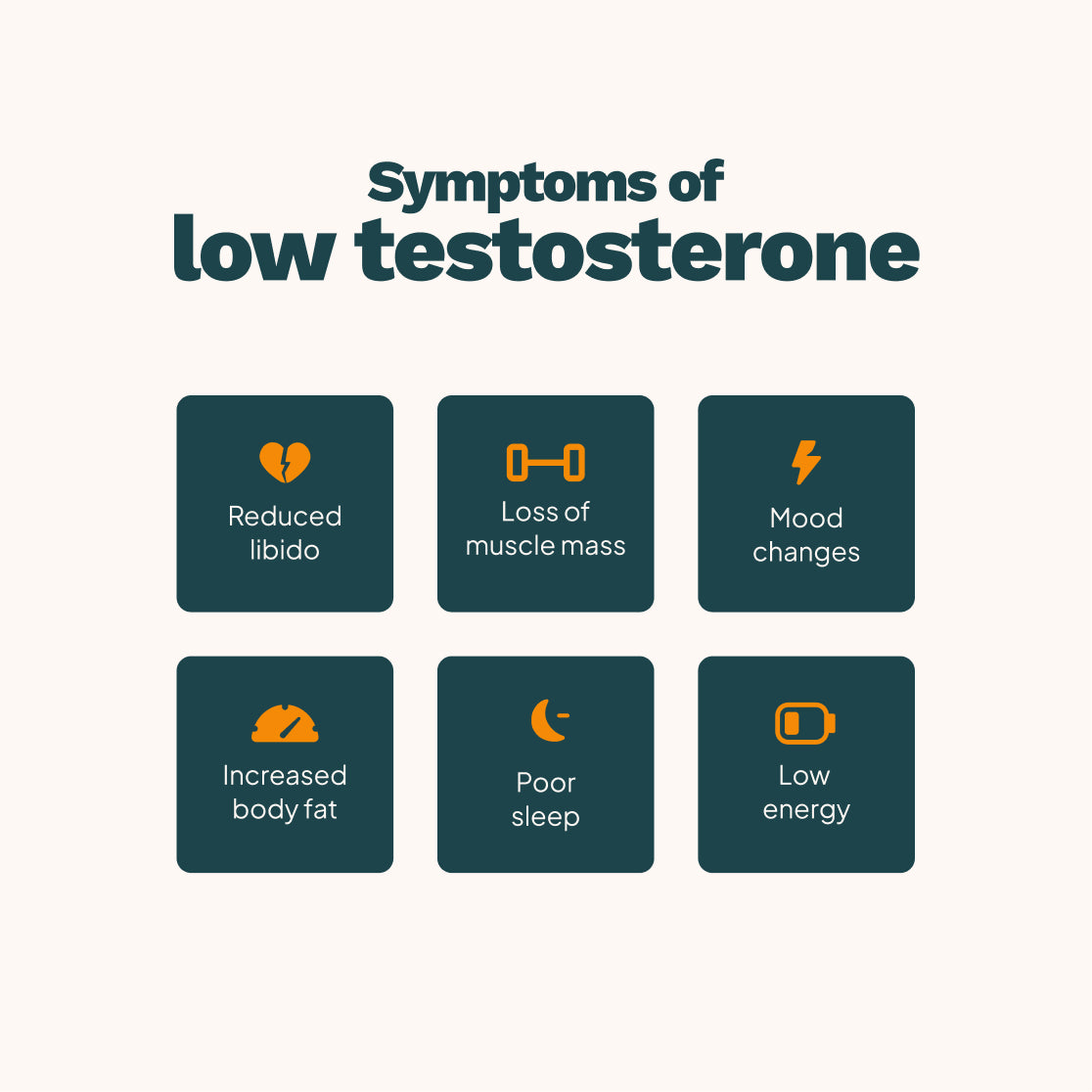
You can’t tell whether a man has a testosterone deficiency by the size of his waist, and weight gain doesn’t automatically point to a hormone problem. However, if it’s accompanied by symptoms such as reduced libido, erectile difficulties, ongoing fatigue, or a noticeable loss of strength, it’s worth getting properly assessed.
A diagnosis depends on the overall pattern of symptoms together with consistently low testosterone levels on repeat morning blood tests. Body shape alone isn’t enough.
For more information, read our guide to low testosterone and weight gain.
How to measure body fat
For most men, trends in weight, waist, and waist-to-height ratio provide practical information without requiring a scan.
Body fat percentage can be useful, but it should not become a false precision target. A change on one bathroom scale may reflect hydration rather than fat loss. Use the same device under similar conditions and look at the direction over several weeks rather than a single reading.
|
Measurement type |
Details |
Notes |
|
BMI |
A quick weight-for-height screening measure |
It does not distinguish fat from muscle or show fat distribution. |
|
Waist and waist-to-height ratio |
A practical estimate of central adiposity and related risk. |
It is not a direct measurement of visceral fat. |
|
Bioelectrical impedance scales |
An estimate of body fat percentage. |
Hydration, meals, exercise, and the device can change the result. |
|
Skinfold callipers |
An estimate based mainly on subcutaneous fat at selected sites. |
Technique matters, and callipers do not measure visceral fat. |
|
DXA scan |
An estimate of total and regional body composition |
Access and cost vary, and the result still estimates visceral fat. |
|
CT or MRI |
More direct quantification of visceral and subcutaneous abdominal fat. |
Not routinely needed for weight management; CT also involves radiation. |
How to measure your waist correctly
To check your waist circumference, a flexible tape measure gives you a simple way to track central adiposity. Stand relaxed and measure against the skin or over a thin layer of clothing [6].
- Find the bottom of your ribs and the top of your hips.
- Place the tape around the midpoint between them, usually just above the belly button.
- Keep the tape horizontal all the way around. It should be snug but not compress the skin.
- Breathe out naturally, without sucking in your stomach, and take the measurement.
- Repeat it. If the two readings differ, measure once more and record the most consistent result.
There is no single healthy waist size for men of every height. A useful rule of thumb is to keep your waist to less than half your height. These thresholds are screening tools only, and risk can occur below a cut-off. For example, some ethnic groups develop type 2 diabetes and cardiovascular disease at a lower BMI and waist size.
If your BMI is 25 or above, measuring your waist is difficult, or if you have existing health conditions, a clinician can provide a more complete assessment.
How to lose belly fat for men
There's no exercise, supplement, food, or cream that selectively burns fat from the stomach. Sit-ups can strengthen your abdominal muscles, but they can't choose where your body burns calories from. The practical answer to losing belly fat is to reduce overall body fat while preserving or building muscle.
Create a sustainable energy deficit
Body fat falls when the body uses more energy than it takes in, although the deficit does not need to be extreme. A diet plan you can stick to is more useful than a strict one you abandon after two weeks. Regular meals built around protein, vegetables, fruit, wholegrain carbohydrates, and unsaturated fats can increase fullness, making portion sizes and the desire to snack easier to manage.
Liquid calories are easy to overlook. Alcohol, sugary drinks, and frequent milky coffees can add substantial energy without providing much fullness. You don’t have to eat perfectly, but it helps to know where your biggest, least satisfying calories are coming from.
Combine aerobic activity with resistance training
Brisk walking, cycling, swimming, and other aerobic activities increase energy expenditure and support heart health, while strength training helps you maintain muscle mass and preserve strength.
A 2024 analysis of 84 randomised trials found that aerobic exercise, resistance training, a combination of the two, and interval training could all help someone to lose weight and reduce visceral fat in people who were overweight or living with obesity [7].
Begin exercising at a comfortable, achievable level, then gradually add more sessions, extend workouts, or increase intensity.
If you have chest pain, severe breathlessness, an injury, or a significant health condition, speak to a healthcare professional before starting any exercise programme.
Protect your sleep
Poor sleep can make managing your weight much harder. Hunger and cravings often feel harder to ignore after a bad night, while tiredness can leave you with little motivation to cook well or exercise.
Track the outcomes that matter
Measure your waist every two to four weeks and consider the broader changes, too. You might be feeling fitter or seeing improvements in your blood pressure or blood test results, even if your scales don’t reflect this.
How do you get rid of visceral belly fat?
You can’t target visceral fat alone or confirm that it has gone with a mirror or tape measure. However, visceral fat responds to the same evidence-based changes that reduce overall adiposity.
Even modest weight loss can be meaningful, especially when it improves glucose control, blood pressure, mobility, sleep, and quality of life.
When clinician-led weight-management treatment may help
If you’ve repeatedly lost and regained weight, are living with obesity, have increased belly fat, or have weight-related conditions, professional support may be worth considering. Obesity can be a long-term condition, and some people benefit from treatment that addresses appetite biology as well as food, activity, sleep, and behaviour.
Weight loss medication may be worth considering for some men, but it won’t be suitable for everyone.
A clinician will need to consider factors such as your BMI, overall health, current medications, symptoms, and treatment goals. Tablets and injections shouldn’t be viewed as a complete solution on their own. If your clinician prescribes them, you should receive ongoing support to manage your weight loss.
If you are considering medication, you may find our guides to GLP-1 weight-loss treatment for men and muscle loss during treatment useful.
Find out whether clinician-led weight-management treatment could be appropriate for you.

References
- Cesaro, A., De Michele, G., Fimiani, F., Acerbo, V., Scherillo, G. et al. (2023) Visceral adipose tissue and residual cardiovascular risk: a pathological link and new therapeutic options. Frontiers in Cardiovascular Medicine, 10, 1187735. (Accessed 25 August 2026).
- Tchernof, A. and Després, J.-P. (2013) Pathophysiology of human visceral obesity: an update. Physiological Reviews, 93(1), pp. 359–404.
- NHS England Digital (2024) Health Survey for England, 2022 Part 2: Adult overweight and obesity. NHS England Digital. (Accessed: 25 August 2026).
- World Health Organisation (2025) Obesity and overweight. World Health Organisation. (Accessed: 25 August 2026).
- NICE (2025) Overweight and obesity management: identifying and assessing overweight, obesity, and central adiposity. National Institute for Health and Care Excellence. (Accessed: 25 August 2026).
- NHS (n.d.) Why your waist size matters. NHS. (Accessed: 25 August 2026).
- Chen, X., He, H., Xie, K., Zhang, L. and Cao, C. (2024) Effects of various exercise types on visceral adipose tissue in individuals with overweight and obesity: a systematic review and network meta-analysis of 84 randomized controlled trials. Obesity Reviews, 25(3), e13666. (Accessed: 27 August 2026).

Share:
What really motivates men to lose weight?
My doctor told me to lose weight. What next?