



Two men can have the same total testosterone result and very different symptoms. One may feel well. The other may have low libido, erectile dysfunction, reduced morning erections, fatigue, or poor recovery.
This is where free testosterone vs total testosterone becomes relevant. Total testosterone is usually the starting point, but it doesn’t always show how much testosterone is available for the body to use. Sex Hormone-Binding Globulin (SHBG), albumin, timing of testing, and underlying health conditions can all change the picture [1].
This article explains the difference between free and total testosterone, how SHBG can affect interpretation, and why further testing may be needed when symptoms do not match the initial result.
- What is total testosterone?
- What is free testosterone?
- Why SHBG matters
- Why two men with the same total testosterone can feel different
- Which matters most – free testosterone or total testosterone?
- What makes a good testosterone blood test?
- When can total testosterone be misleading?
- What symptoms should be taken seriously?
- What if your testosterone is normal, but you still have symptoms?
- When should you seek advice?
What is total testosterone?
Total testosterone is the total amount of testosterone circulating in the blood. It includes testosterone that is:
- Tightly bound to SHBG
- More loosely bound to albumin
- Unbound, or free
Total testosterone is usually the first marker assessed because it’s widely available, clinically useful, and often enough when symptoms and results clearly align.
A clearly low total testosterone result, especially when repeated under the right testing conditions, can support a diagnosis of testosterone deficiency when symptoms are also present.
What is free testosterone?
Free testosterone is the small proportion of testosterone that is not bound to SHBG or albumin. It is more readily available to tissues and can give useful additional information when total testosterone doesn’t explain the whole picture.
In practice, free testosterone is often calculated using total testosterone, SHBG, and albumin. This is generally preferred over a direct free testosterone immunoassay – a lab test that uses antibodies to measure a hormone in the blood. While immunoassays are useful for many tests, direct free testosterone immunoassays can be less reliable for medical decision-making.
Equilibrium dialysis is considered the most accurate method for measuring free testosterone. It works by separating free testosterone from protein-bound testosterone in a blood sample, allowing the free fraction to be measured more directly. However, because it is more complex and less widely available, calculated free testosterone is commonly used in clinical practice [2].
Why SHBG matters
Sex hormone-binding globulin (SHBG) is a carrier protein that binds testosterone in the blood.
If SHBG is high, more testosterone is tightly bound, which can reduce the amount available as free testosterone. If SHBG is low, total testosterone may look lower, but the free testosterone result may tell a different story.
SHBG can be affected by several factors, including:
- Age
- Liver disease
- Thyroid disease
- Obesity
- Insulin resistance
- Type 2 diabetes
- Smoking
- Some medications
- Anabolic steroid use
Why two men with the same total testosterone can feel different
A total testosterone result does not exist in isolation. Two men may have the same total testosterone level but different SHBG levels, free testosterone levels, and underlying health factors.

Which matters most – free testosterone or total testosterone?
Total testosterone provides the initial biochemical picture and is the most commonly used result to assess possible testosterone deficiency. However, total testosterone isn’t always enough, especially when the result is borderline or when SHBG is likely to be abnormal.
Free testosterone becomes more useful when:
- Total testosterone is borderline
- Symptoms are present, but total testosterone appears normal
- SHBG is high or low
- Obesity, type 2 diabetes, thyroid disease, liver disease, or certain medications may be affecting SHBG
- Previous testosterone results don’t fit the symptom pattern
What makes a good testosterone blood test?
A testosterone blood test is most useful when it’s taken under the right conditions.
Testosterone has a daily rhythm and is usually highest in the morning, which is why we ask for testing to be done at the right time of day. Poor sleep, acute illness, night shifts, heavy exercise, high stress, and some medications can all temporarily affect the result.
If your first blood test shows low testosterone, we’ll usually ask you to repeat the test around four weeks later before making treatment decisions. This second test is important because a single low reading can sometimes reflect a short-term factor rather than a consistent testosterone deficiency.
A useful testosterone blood test can include:
- Total testosterone
- SHBG
- Albumin
- Calculated free testosterone
- LH and FSH
- Other relevant health markers, depending on symptoms and history
Luteinising hormone (LH) and follicle-stimulating hormone (FSH) help distinguish whether the problem is more likely to sit at the level of the testes or with signaling from the brain and pituitary gland [1].
When can total testosterone be misleading?
Total testosterone can be harder to interpret when SHBG is outside the expected range.
SHBG may be lower in men with:
- Obesity
- Insulin resistance
- Type 2 diabetes
- Hypothyroidism
- Non-alcoholic fatty liver disease
- Anabolic steroid use.
SHBG may be higher with:
- Ageing
- Smoking
- Hyperthyroidism
- Liver disease
- Some medications
In these situations, total testosterone can give an incomplete view. Calculated free testosterone may help determine whether there is enough available testosterone to match the clinical picture.
What symptoms should be taken seriously?
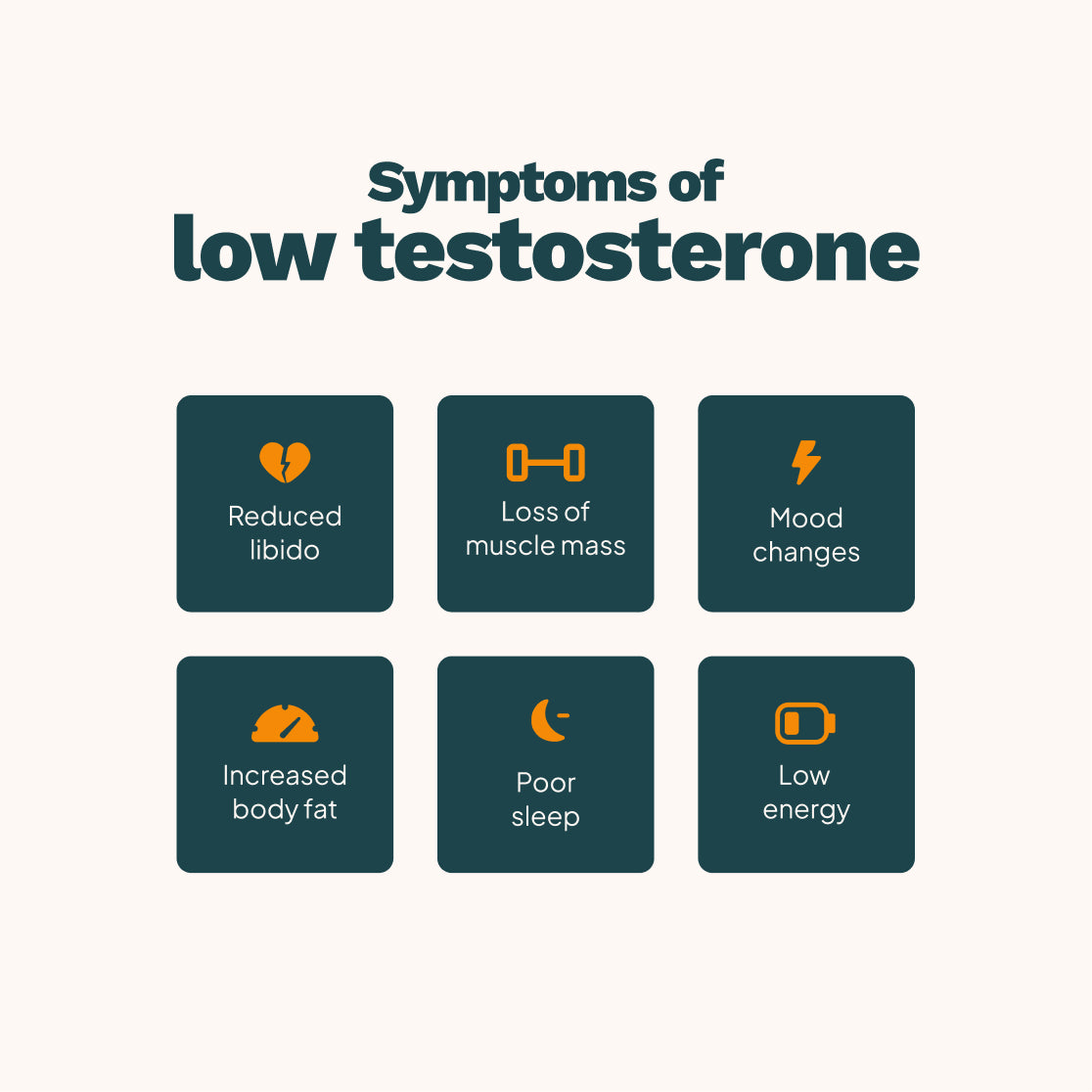
Symptoms should always be interpreted carefully because many are non-specific. Fatigue, low mood, weight gain, poor concentration, and reduced motivation can have many causes.
Sexual symptoms tend to be more specific to testosterone deficiency.
These include:
- Low libido
- Erectile dysfunction
- Fewer morning erections
Other symptoms may include:
- Reduced shaving frequency
- Loss of body hair
- Reduced testicular volume
- Infertility
- Hot flushes
- Low bone density
- Anaemia
- Reduced physical performance
Symptoms or results alone are not enough for a diagnosis; a professional consultation with a clinician will depend on both.
What if your testosterone is normal, but you still have symptoms?
A “normal” result does not always close the case.
The first step is to check whether the test was done properly:
- Was it taken in the morning?
- Was it repeated?
- Was SHBG measured?
- Was free testosterone calculated?
- Were LH, FSH, and prolactin checked where appropriate?
If only total testosterone were measured, the assessment may be incomplete, especially if symptoms are consistent with testosterone deficiency.
Learn more about having a normal testosterone blood test result, but displaying symptoms, or how to take a testosterone blood test.
When should you seek advice?
It’s worth seeking advice if you have persistent low testosterone signs or a testosterone result that does not match your symptoms.
It’s also worth getting specialist input if your result is borderline, if SHBG is abnormal, or if you have obesity, type 2 diabetes, thyroid disease, liver disease, or a history of anabolic steroid use.
At Leger, treatment is based on a thorough understanding of your symptoms and assessment of their underlying causes. Testosterone results and next steps are considered in context rather than in isolation.
Not sure where to start? Use our simple Get Started tool.
References
- Bhasin, S., Brito, J.P., Cunningham, G.R., Hayes, F.J., Hodis, H.N., Matsumoto, A.M., Snyder, P.J., Swerdloff, R.S. and Wu, F.C.W. (2018) ‘Testosterone therapy in men with hypogonadism: an Endocrine Society clinical practice guideline’, The Journal of Clinical Endocrinology & Metabolism, 103(5), pp. 1715–1744. doi: 10.1210/jc.2018-00229.
- European Association of Urology (2026) Sexual and Reproductive Health Guidelines: Male hypogonadism. Available at: https://uroweb.org/guidelines/sexual-and-reproductive-health/chapter/male-hypogonadism (Accessed: 23 June 2026).

Share:
What happens to your testicles on TRT?
High haematocrit on TRT: when should you be concerned?