


Here’s a surprising fact: smokers often have higher testosterone than men who don’t smoke. In some studies, up to 15% higher [1].
That’s strange for a habit that can damage your erections and sperm health.
So, what’s going on every time you light up, and what changes when you stop?
Contents
- The link between smoking and testosterone
- Why do cigarettes increase testosterone?
- What happens to testosterone when you quit?
- What about vaping?
- Erections and fertility after quitting
- Other benefits of quitting
The twist: smokers really do have higher testosterone
The evidence is pretty consistent.
A 2023 analysis of over 25,000 men found that current smokers had total testosterone levels about 0.9 nmol/L higher than men who’d never smoked, even after accounting for things like age and body weight [2]. Another analysis of over 13,000 men landed in the same place, with smokers about 1.5 nmol/L higher on average [3]. Free testosterone tends to be higher too [4]. You can read more about free vs total testosterone in our guide.
But we’re talking small changes. And that doesn’t necessarily mean that smokers feel better for it. They’re not getting more energy, stronger erections, or better fertility as a result. In fact, smoking can damage all three, so that’s not a reason to start.
Why would cigarettes push testosterone up?
Researchers have a few suspects:
- More SHBG – Smoking is linked to higher levels of sex hormone-binding globulin (SHBG), a protein that carries testosterone around your blood. More SHBG means more bound testosterone, which can push up the total amount on your blood results [5].
- Slower breakdown – Nicotine and its breakdown products may change how quickly your body clears testosterone. Nobody’s sure how much this matters [3].
- More LH – Compounds in smoke may raise luteinising hormone (LH), which signals your testicles to make testosterone [6].
These are just a few theories that might explain it. These reasons in revers might also explain the changes when you quit.
What happens to testosterone when you quit?
If you were hoping quitting would give your testosterone a boost, that's usually not the case. Studies generally find testosterone falls slightly or stays put [7].
Two separate studies found a small drop after quitting, even after accounting for other factors that affect testosterone [8,9].
The exact reason isn’t clear. Part of the explanation might be that the hormonal effects of smoking start to reverse. SHBG tends to fall within the first week [7]. Researchers have also proposed changes in the hormonal signals involved in testosterone production [4]. In other words, testosterone levels may drift back towards where a non-smoker’s would sit.
Weight gain after quitting could also play a part, since extra body fat can lower testosterone. Some studies still find a decline even after accounting for weight, so it’s unlikely to be the whole story [10]. If weight gain is a concern for you, weight management medications can be an effective option for many men.
What about vaping?
Here’s where the evidence is a little hazy.
Most vapes contain nicotine but don’t burn tobacco. So, do they have the same effect on testosterone?
So far, we don’t know. One rat study found that exposure to e-cigarette refill liquid was linked to lower testosterone and signs of testicular oxidative stress, although the liquid was injected rather than inhaled [11]. Meanwhile, a study of over 1,200 young men found no significant difference in testosterone levels between those who vaped and those who didn’t. Vaping was associated with lower sperm counts, although the study couldn’t establish cause and effect [12].
For now, we don’t have enough evidence to say whether vaping increases, decreases, or has no meaningful effect on testosterone.
What we do know is that vaping is less harmful than smoking cigarettes. It can help some smokers quit, but it’s not risk-free, and its long-term effects aren’t fully understood [13].
The good news: erections and fertility can bounce back
Even though you may experience a marginal drop in testosterone, there are other benefits to stopping.
Erections depend on blood flow as much as hormones. Smoking damages blood vessels and restricts blood flow to the penis, which is why a smoker can have perfectly normal testosterone and still struggle. If erections are a problem for you, quitting smoking is a good place to start. There are also treatments for erectile dysfunction that can help, depending on the underlying cause.
How smoking cessation affects sex life and fertility:
- Erections – In a study of men aged 30 to 60, scores for erections and overall sexual function were better six months after quitting [14]. The caveat is that in heavy, long-term smokers, some damage may be permanent, so improvements can be less noticeable [15].
- Sperm – A 2025 study followed 60 men before they quit, then at three and six months afterwards. Sperm count, movement, and shape all improved. Some of these changes are likely to help fertility [16].
Other reasons to quit (the list is long)
The benefits of quitting start almost immediately.
- Within days: Carbon monoxide levels in your blood return towards non-smoker levels, so your blood can carry oxygen more effectively. Smell and taste improve too [17].
- Weeks to months: Circulation and lung function improve, and coughing and breathlessness often ease [17].
- Long term: After a year, the risk of a heart attack is substantially lower and continues to fall [17]. Your risk of stroke, COPD, and at least 12 types of cancer falls [18]. Quitting can also add up to 10 extra years to your life expectancy, depending on when you stop [19].
There are social and mental health benefits too. Find out more about the benefits of quitting.
The bottom line
Smoking can slightly bump up your testosterone result while damaging the systems that testosterone is supposed to support. Quitting may nudge that number down a little, but it also gives your blood vessels, sperm, and long-term health a chance to recover.
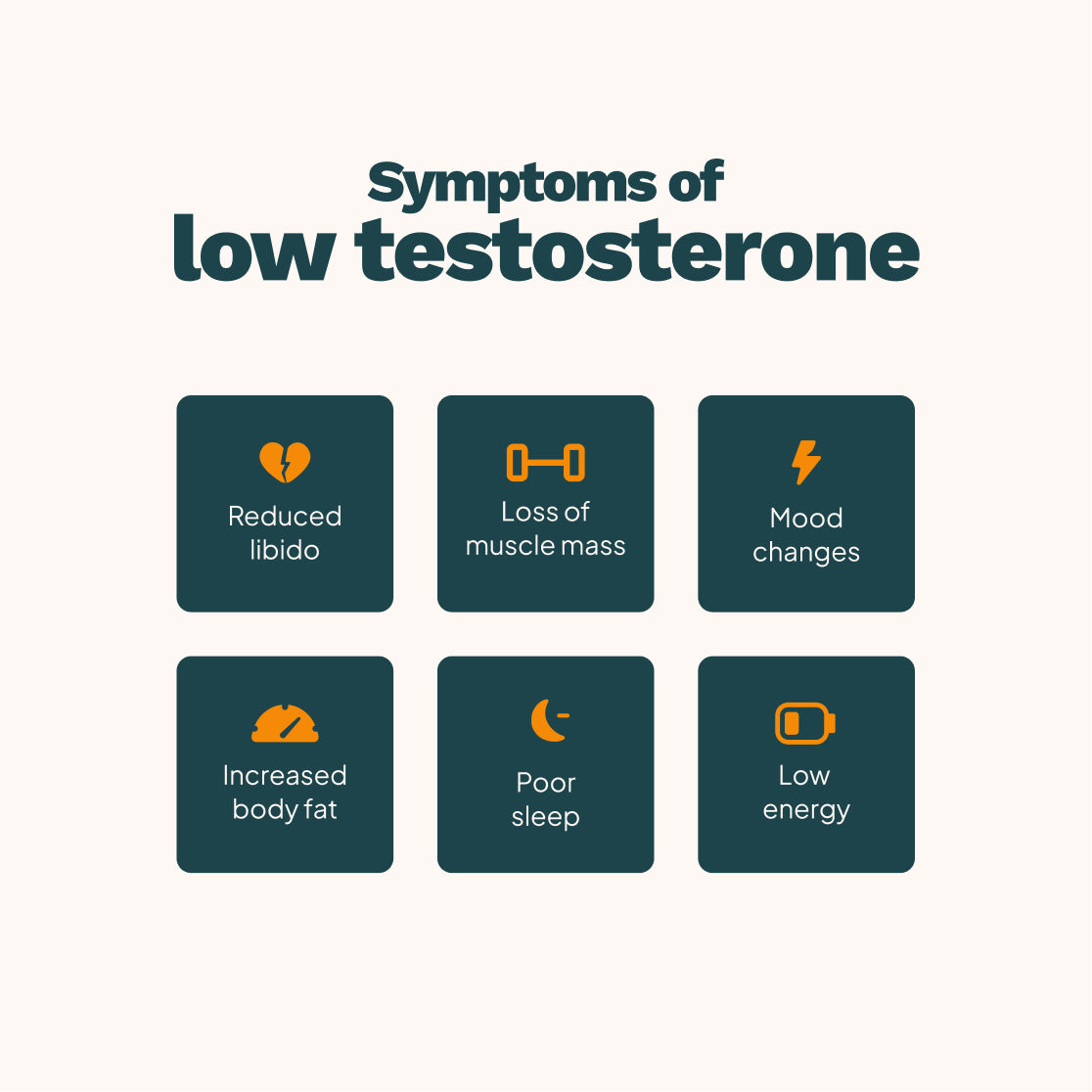
If you've quit smoking but still struggle with low libido, fatigue, or other symptoms of low testosterone, don't assume they're a consequence of giving up cigarettes. A testosterone blood test can help establish whether your hormone levels might be involved.
References
- Svartberg J, Jorde R. Endogenous testosterone levels and smoking in men. The fifth Tromsø study. Int J Androl. 2007;30:137–143.
- Factors Associated With Circulating Sex Hormones in Men: Individual Participant Data Meta-analyses. Ann Intern Med. 2023;176(9).
- Zhao J, Leung JYY, Lin SL, Mary Schooling C. Cigarette smoking and testosterone in men and women: A systematic review and meta-analysis of observational studies. Prev Med. 2016;85:1–10.
- Wang W, Yang X, Liang J, Liao M, Zhang H, Qin X, et al. Cigarette smoking has a positive and independent effect on testosterone levels. Hormones. 2013;12:567–577.
- English KM, Pugh PJ, Parry H, Scutt NE, Channer KS, Jones TH. Effect of cigarette smoking on levels of bioavailable testosterone in healthy men. Clin Sci. 2001;100:661–665.
- Trummer H, Habermann H, Haas J, Pummer K. The impact of cigarette smoking on human semen parameters and hormones. Hum Reprod. 2002;17:1554–1559.
- Hruškovičová H, Dušková M, Simůnková K, Hill M, Pospíšilová H, Rácz B, et al. Effects of smoking cessation on hormonal levels in men. Physiol Res. 2013;62:67–73.
- Shi Z, Araujo AB, Martin S, O’Loughlin P, Wittert GA. Longitudinal Changes in Testosterone Over Five Years in Community-Dwelling Men. J Clin Endocrinol Metab. 2013;98:3289–3297.
- Camacho EM, Huhtaniemi IT, O’Neill TW, Finn JD, Pye SR, Lee DM, et al. Age-associated changes in hypothalamic–pituitary–testicular function in middle-aged and older men are modified by weight change and lifestyle factors: longitudinal results from the European Male Ageing Study. Eur J Endocrinol. 2013;168:445–455.
- Jandikova H, Duskova M, Simunkova K, Racz B, Hill M, Kralikova E, et al. The steroid spectrum during and after quitting smoking. Physiol Res. 2015;64:S211–S218.
- El Golli N, Rahali D, Jrad-Lamine A, Dallagi Y, Jallouli M, Bdiri Y, et al. Impact of electronic-cigarette refill liquid on rat testis. Toxicol Mech Methods. 2016;26:427–434.
- Holmboe SA, Priskorn L, Jensen TK, Skakkebaek NE, Andersson A-M, Jørgensen N. Use of e-cigarettes associated with lower sperm counts in a cross-sectional study of young men from the general population. Hum Reprod. 2020;35:1693–1701.
- NHS Better Health. Vaping myths and facts. NHS.
- Sahin MO, Sen V, Gunduz G, Ucer O. Effect of smoking cessation on sexual functions in men aged 30 to 60 years. Int Braz J Urol. 2020;46:642–648.
- Pourmand G, Alidaee MR, Rasuli S, Maleki A, Mehrsai A. Do cigarette smokers with erectile dysfunction benefit from stopping?: a prospective study. BJU Int. 2004;94:1310–1313.
- Evaluating the effect of smoking and its cessation on semen parameters. Reprod Fertil. 2025;6.
- NHS Better Health. What could happen when you quit smoking. NHS.
- U.S. Department of Health and Human Services. Smoking Cessation: A Report of the Surgeon General – Key Findings. 2020.
- Jha P, Ramasundarahettige C, Landsman V, Rostron B, Thun M, Anderson RN, et al. 21st-century hazards of smoking and benefits of cessation in the United States. N Engl J Med. 2013;368:341–350.

Share:
My doctor told me to lose weight. What next?
The link between testosterone and cholesterol